Redefining Perceptions of Domestic Abuse
-

When people picture domestic abuse, they often imagine a man using violence against a woman. That happens, and it must be taken seriously. But abuse can also be less visible. It can involve intimidation, control, and a gradual loss of confidence. Men can experience it too. This is my account of abuse in a relationship with a woman, and of what happened when I sought help. I felt that assumptions about who an abuser or a victim could be made it harder for me to be heard. I want to show how those assumptions affected me, and why they matter. I have chosen not to name the people involved. This account is based on my experience, with messages, records, and witnesses supporting the events I describe.
This is my account of abuse in a relationship with a woman, and of what happened when I sought help. My experiences with the police, social services, Cafcass, and the courts left me feeling that, as a man, I was prejudged rather than heard. At times, I felt their responses allowed the situation to continue. I want to show what happened in each setting and let readers examine the evidence for themselves.
The impact has reached into every part of my life. Mentally, I have lived with the strain of trying to explain what happened while feeling unheard. Financially, dealing with the consequences has taken resources I could have used to rebuild. Most painful of all has been the effect on my relationships with my children—time and closeness that I can’t simply get back. I want to describe that cost honestly, alongside the events that led to it.
In The Beginning
Before we met, I’d recently come out of a three-year relationship that ended on friendly terms. We cared about each other, but our circumstances meant we couldn’t build a longer-term life together. I was feeling positive about what might come next. At work, a colleague who had been single for some time agreed to try online dating if I joined him. That’s how I came to meet her. Our first messages, in late September 2016, were easy and warm. We talked about running, work, our children, and things we hoped to do with our lives. She came across to me as thoughtful, funny, and open. Within the first couple of days, she told me that her marriage had become abusive and that leaving had been difficult. I took her account seriously and admired what I understood to be her courage. She also spoke about valuing honesty, which mattered to me. The conversation grew quickly, but it didn’t feel one-sided. We both looked forward to speaking, and after we first met in October, our messages show that we were excited to see each other again. That is where this story begins. With a connection I believed was genuine and a future I felt hopeful about.
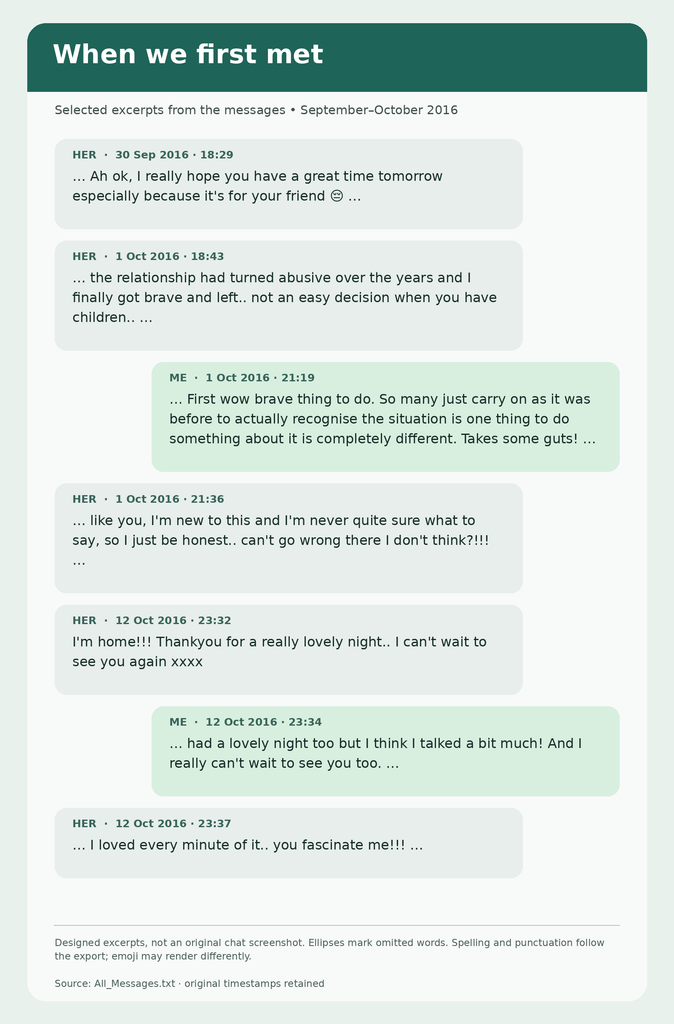
At the beginning, being with her felt easy. Our messages were warm and often funny, and after we met, I felt comfortable with her surprisingly quickly. She arrived at our first date with presents. I appreciated the thought, but it caught me off guard. Later, she bought me a camera. That generosity felt difficult to accept so early. I didn’t want to take it, but I worried that refusing would seem unkind. I was pleased that she wanted to make me happy, but at the same time, I felt a quiet pressure to match the pace of what she was giving. I didn’t have a name for that feeling then. I just knew things were moving quickly, and I was trying to be kind and keep things smooth.
Early on, she told me that her marriage had been abusive, though she also said she and her ex got on well now. Over the following weeks, she told me more about what she said life with him had been like—that he had barely let her leave the house, that she hadn’t been allowed friends, and that she had once felt unable to live her own life. Later she described a restriction on her phone, and being called a bad mother. There were also things she said about the children hearing him talk to her harshly. At the time, with only her account, I had no reason to doubt her. I felt protective and wanted to be someone she and the children could rely on. These were her accounts to me. I had not witnessed the earlier events myself.
<reinforcing having it hard>
<Positive things>
<Tricking me to meet the children>
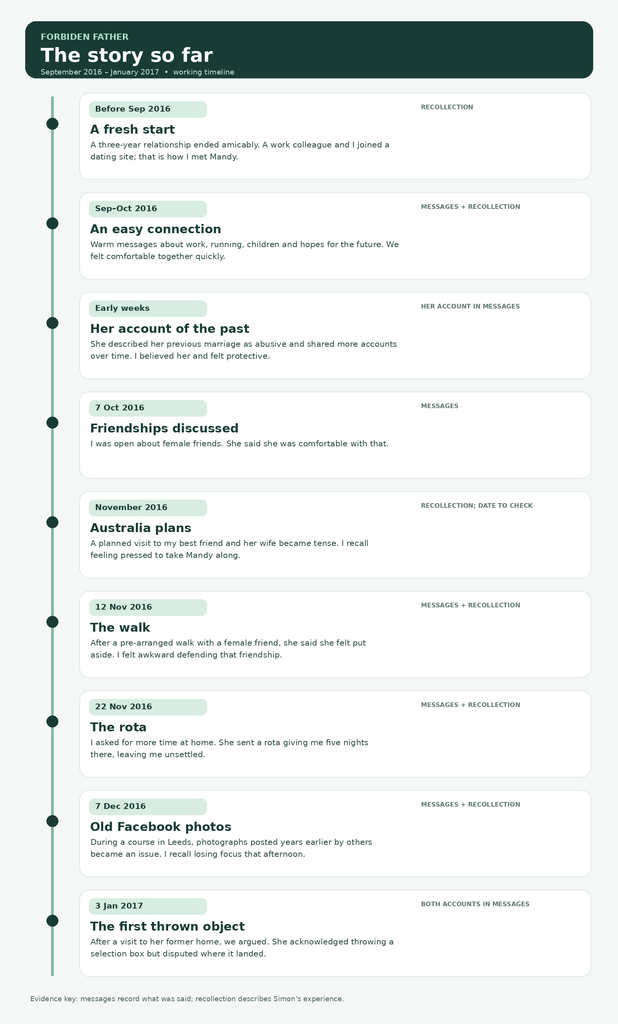
When we first began talking, I was open about having female friends. She told me she had no problem with that and said her male friends mattered to her too. So when I went on a walk with a female friend on 12 November, something we had arranged beforehand, I did not expect it to cause a problem. I kept in touch during the day and planned to see her afterwards, although the walk and conversation took longer than I had expected. That evening when I went to see her she was very sulky and short with me. Eventually she said she felt I had put her and the children aside to spend time with another woman. I tried to explain and reassure her, but I also found myself defending a friendship I thought she had accepted. It left me feeling awkward: I wanted to take her feelings seriously, yet I began to wonder whether I could make ordinary plans with friends without having to account for them afterwards. After a short time together it didn’t feel right for her to react like this but I tried to be understanding and questioned myself if I was the one over reacting by feeling this way.
I had already planned a trip to Australia to visit my best friend and her wife before we had met. I had very open about the friendship, and at first she had said she was comfortable with me having such a close female friend. As the trip approached, I remember her becoming uneasy about my going alone and asking me to cancel or delay it. I suggested that she might come with me, thinking it would be difficult for her to arrange childcare at such short notice. She was able to make arrangements, so I booked the trip together. I tried to put a brave face on it, but I felt pressured. A visit to someone important to me had become something I no longer felt comfortable that I could do on my own. It had started to feel like it was that or having to decide between the two. There was a lot of passive comments and I felt that maybe if they were to meet that it may remove any concerns and life would be easier moving forward. Something I was to learn was not to be the case.
By late November, I realised I was spending so many nights away at her house that I barely had time at home to look after my house and my cats. I was spending hours going back to see the cats and return at her request. I decided to suggest keeping regular nights at home. She raised about feeling unsafe on her own and used her issues of her marriage as the main reason and likening having someone around to feel safe. When another evening out came up, I asked if we could sit down together the next day and look at the calendar before adding more plans. Instead, she sent me a revised rota saying I would have five nights a week at home. That was a much bigger change than I had asked for, and I felt as though a practical conversation about balance had suddenly become a decision about when we would see each other. I knew she had told me about difficult past relationships, so I tried to understand why my request might have unsettled her. But the speed and scale of the response unsettled me too. I found myself repeatedly explaining that I wanted to be with her; I simply needed enough time to keep up with my own life.

In December, while I was on a work course in Leeds, she called me out of the blue midmorning. I thought it was an emergency or something was wrong. I soon found she had been stalking my Facebook account and it was about photographs from years before we met. They were on other people’s Facebook pages and I had only been tagged. There was noting unusual or odd about the photographs it was just that they were on, or included, other females. They were clearly innocent pictures of being with friends. I having to leave the course to take her call, during which she was very animated and pressed to have them removed. That felt odd and unsettling. I had already deleted the pictures I controlled, yet now I was being told to contact others and tell them to remove their posts. In her messages that morning, she said those pictures were hurtful. I wanted to reassure her, but the call pulled me out of the course and stayed on my mind for the rest of the day. What may have been one conversation for her left me distracted at work and anxious about what else from my past might suddenly become a problem between us.
By this point I was starting to realise all these generally low level issues shows a worrying patter moving from “what will upset her?” to “will my actions be described in a way I don’t recognize?” None of these moments felt like the whole story on its own. What affected me was how quickly an ordinary part of my life could become something I had to explain, reassure, and then explain again. By late November I was describing it as a minefield. I still cared about her and wanted it to work, but I was becoming anxious about what might cause the next argument. What she had used the abuse she describe from her marriage I started to feel there may be something more than a hangover from that.
<Issues at Christmas/issues with husband not been honest>
Reality Bites
Just after our first Christmas together, she asked me to go with her to the house where she had once lived with her former husband, now occupied by a friend. I felt it a little odd taking me there and soon realised the person there was not actually a friend. I had come straight from work and remember sitting there for several hours, hungry and increasingly uncomfortable. I was not included in any of the discussion she had with the occupier of her old home and was pretty much ignored for over 4 hours. When we left I later told her I felt overlooked, the conversation escalated. When I stopped at her house she became very animated. I remember her shouting and throwing the children’s presents she had received from the occupier of her old house at me before storming off. I left feeling shaken. It was the first time an argument between us had become physical. In messages that night, I she confirms she had thrown things at me. The next morning, she acknowledged throwing a selection box, though she tried to disputed where the box landed and gave a very different account of the argument. It concerned me that she acknowledged throwing it, I realise now it was a warning that she disputed the events of what happened to suit her own ends and did not take responsibility for throwing things at me. I tried to put it to one side at the time but I was soon to learn this wasn’t isolated behaviour in actions nor in changing the truth.
<questioning if I should walk away>

<need to get out and planning that in my head>
<Australia behaviour>
<the hitting incident>
<Pregnant>
<Scan in Derby>
<False baby heartbeat issues>